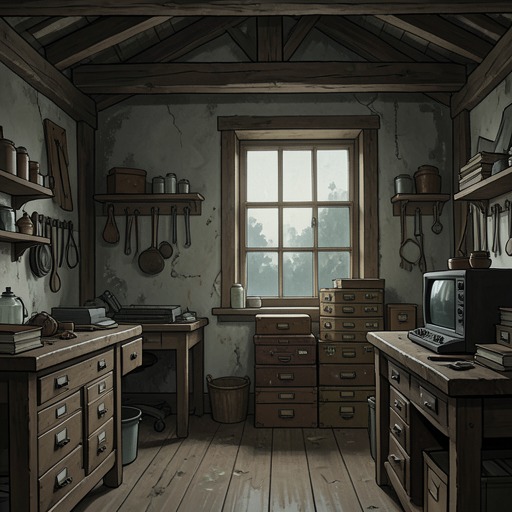
Les presses en bois de l’imprimerie Séchard
Illusions perduesThe three wooden presses in Jérôme-Nicolas Séchard’s Angoulême printing shop are working machines, objects of attachment, and the focus of a father-son dispute over the value of inherited craft. As David takes over the business, the presses become a test of what counts as improvement: for the trained printer, they are outdated equipment; for his father, they are reliable tools whose familiar operation can still earn a living.
Construction and Use
At the opening of the story, provincial printing has not yet adopted the Stanhope press or mechanical rollers for distributing ink. Angoulême’s printers still work with wooden presses, leather balls for applying ink to the type, and a movable stone bed traditionally called a marble. The old mechanism depends on handwork: a pressman inks the assembled letters, positions the sheet, and works the press through its successive movements. The wooden machines belong to a practical system of production rather than serving as inert relics; their components, and the workers’ practiced handling of them, make printing possible.
The inventory presented to David lists three wooden presses strengthened with iron bars and fitted with cast-iron beds, along with their accessories: inkstands, inking balls, benches, and other equipment. Jérôme-Nicolas emphasizes the iron bars as an improvement he himself made. The presses stand at the center of a much larger, meticulously itemized stock. The old printer counts not just the machinery but type, small sheets of paper, boards, tubs, washing stones, brushes, and even the cords used for drying printed sheets. The total valuation reaches 30,000 francs, including the master printer’s license and the shop’s customer base; the presses are therefore part of a whole working establishment, not an isolated purchase.
The Demonstration and Dispute
David, educated in Paris and trained at the Didot Printing House, dismisses the presses as worn-out wooden contraptions that should be replaced. His father insists that judgment should follow demonstration. He hurries down to the workshop, where the presses have been carefully oiled and cleaned, and points to their strong oak uprights. A wedding announcement is ready for printing. Jérôme-Nicolas lowers the frisket and tympan, rolls the bed beneath the press, draws the bar, and uses the cord to bring the bed back. He then raises the tympan and frisket, performing the familiar sequence with the quickness of a much younger pressman. The machine gives a brief, light sound as it works. He repeats the same operation at the other two presses, noticing a neglected spot on the last and wiping it with his coat.
The scene makes the older man’s competence tangible. His defense is not based on technical learning—he admits that David knows more—but on years of operating these particular machines and judging their condition through use. He argues that the presses can produce clean work without requiring repairs throughout David’s working life. He estimates that the three could bring in 9,000 francs a year even without a foreman, presenting continued use as a sound business decision as well as a matter of loyalty.
Technology, Price, and Practical Value
Jérôme-Nicolas contrasts the wooden presses with the imported Stanhope machines David has seen in Paris. He says a Stanhope costs 2,500 francs apiece, while his three presses together are worth much less; he further argues that the iron mechanism lacks the elasticity needed to protect the type. In his view, the newer press wears down the letters, so mechanical speed and novelty do not necessarily improve the economics of a small shop. The old equipment’s value lies in its durability, repair needs, and suitability for the work local customers will pay for.
That last point shapes his broader argument. Impressions made with iron or wood, he says, bring in no extra payment from Angoulême’s customers. He invokes the persistence of provincial habits: a printer cannot assume that better-looking novelties will sell simply because they are technically or aesthetically superior. His example is the local preference for a familiar almanac over more elaborate alternatives. The presses thus stand for an approach to business grounded in what customers actually buy, however limiting that approach may be for a younger printer trained in more advanced methods.
Inheritance and Significance
The presses carry a personal history as well as a commercial price. Jérôme-Nicolas has worked with wooden machinery for decades, and his confidence in it is bound up with his identity as a pressman who learned the trade through practice. His attachment is explicitly described as almost superstitious. When he demonstrates the presses, he defends not only their construction but the tools through which he supported himself and raised David. The machines make that inheritance visible, while the detailed inventory converts it into a sum David must consider accepting or rejecting.
For David, the disagreement reveals how difficult it will be to separate sound technical judgment from the terms imposed by his father. The presses are demonstrably operable, yet their usefulness does not settle whether the whole valuation is fair or whether the business should remain equipped for an older mode of production. As objects, they occupy both sides of that tension: they are real, serviceable machines, and they are also the material evidence Jérôme-Nicolas uses to defend his authority and define what his son is receiving. Their significance comes from that double function, as instruments of printing and instruments in a negotiation over labor, knowledge, and ownership.